Unit 1 - Introduction to Software Process
- Unit 1 - Introduction to Software Process
- Introduction to Software Engineering
- Software Process
- Software Development Life Cycle (SDLC)
- Waterfall model
- Spiral Model
- Incremental Model
- Agile Model
- Project Management
- COCOMO Model
- Risk Management
- References
Introduction to Software Engineering
Software is a program or set of programs containing instructions that provide desired functionality. And Engineering is the process of designing and building something that serves a particular purpose and finds a cost-effective solution to problems.
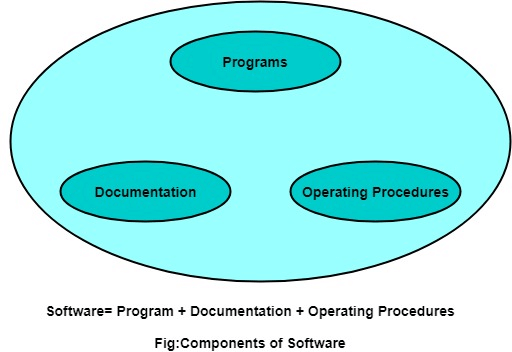
Software Engineering is the process of designing, developing, testing, and maintaining software. It is a systematic and disciplined approach to software development that aims to create high-quality, reliable, and maintainable software. Software engineering includes a variety of techniques, tools, and methodologies, including requirements analysis, design, testing, and maintenance.
Key Principles of Software Engineering
- Modularity: Breaking the software into smaller, reusable components that can be developed and tested independently.
- Abstraction: Hiding the implementation details of a component and exposing only the necessary functionality to other parts of the software.
- Encapsulation: Wrapping up the data and functions of an object into a single unit, and protecting the internal state of an object from external modifications.
- Reusability: Creating components that can be used in multiple projects, which can save time and resources.
- Maintenance: Regularly updating and improving the software to fix bugs, add new features, and address security vulnerabilities.
- Testing: Verifying that the software meets its requirements and is free of bugs.
- Design Patterns: Solving recurring problems in software design by providing templates for solving them.
- Agile methodologies:Using iterative and incremental development processes that focus on customer satisfaction, rapid delivery, and flexibility.
- Continuous Integration & Deployment: Continuously integrating the code changes and deploying them into the production environment.
Software Process
The term software specifies to the set of computer programs, procedures and associated documents (Flowcharts, manuals, etc.) that describe the program and how they are to be used.
A software process is the set of activities and associated outcome that produce a software product. Software engineers mostly carry out these activities. These are four key process activities, which are common to all software processes. These activities are:
- Software specifications: The functionality of the software and constraints on its operation must be defined.
- Software development: The software to meet the requirement must be produced.
- Software validation: The software must be validated to ensure that it does what the customer wants.
- Software evolution: The software must evolve to meet changing client needs.
The Software Process Model
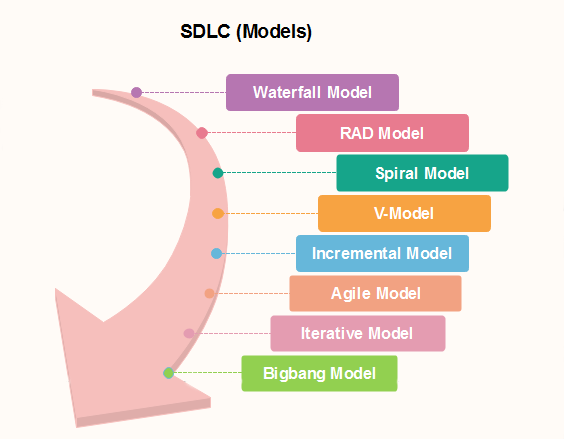 A software process model is a specified definition of a software process, which is presented from a particular perspective. Models, by their nature, are a simplification, so a software process model is an abstraction of the actual process, which is being described. Process models may contain activities, which are part of the software process, software product, and the roles of people involved in software engineering. Some examples of the types of software process models that may be produced are:
- A workflow model: This shows the series of activities in the process along with their inputs, outputs and dependencies. The activities in this model perform human actions.
- 2. A dataflow or activity model: This represents the process as a set of activities, each of which carries out some data transformations. It shows how the input to the process, such as a specification is converted to an output such as a design. The activities here may be at a lower level than activities in a workflow model. They may perform transformations carried out by people or by computers.
- 3. A role/action model: This means the roles of the people involved in the software process and the activities for which they are responsible.
Software Development Life Cycle (SDLC)
SDLC stands for software development life cycle. It is a process followed for software building within a software organization.SDLC consists of a precise plan that describes how to develop, maintain, replace, and enhance specific software. The life cycle defines a method for improving the quality of software and the all-around development process.

Need for SDLC
SDLC is a method, approach, or process that is followed by a software development organization while developing any software. SDLC models were introduced to follow a disciplined and systematic method while designing software. With the software development life cycle, the process of software design is divided into small parts, which makes the problem more understandable and easier to solve. SDLC comprises a detailed description or step-by-step plan for designing, developing, testing, and maintaining the software.
Stage-1: Planning and Requirement Analysis
Planning is a crucial step in everything, just as in software development. In this same stage, requirement analysis is also performed by the developers of the organization. This is attained from customer inputs, and sales department/market surveys.
The information from this analysis forms the building blocks of a basic project. The quality of the project is a result of planning. Thus, in this stage, the basic project is designed with all the available information.
Stage-2: Defining Requirements
In this stage, all the requirements for the target software are specified. These requirements get approval from customers, market analysts, and stakeholders.\ This is fulfilled by utilizing SRS. This is a sort of document that specifies all those things that need to be defined and created during the entire project cycle.
Stage-3: Designing Architecture
SRS is a reference for software designers to come up with the best architecture for the software. Hence, with the requirements defined in SRS, multiple designs for the product architecture are present in the DDS.\ This DDS is assessed by market analysts and stakeholders. After evaluating all the possible factors, the most practical and logical design is chosen for development.
Stage-4: Developing Product
At this stage, the fundamental development of the product starts. For this, developers use a specific programming code as per the design in the DDS. Hence, it is important for the coders to follow the protocols set by the association. Conventional programming tools like compilers, interpreters, debuggers, etc. are also put into use at this stage. Some popular languages like C/C++, Python, Java, etc. are put into use as per the software regulations.
Stage-5: Product Testing and Integration
After the development of the product, testing of the software is necessary to ensure its smooth execution. Although, minimal testing is conducted at every stage of SDLC. Therefore, at this stage, all the probable flaws are tracked, fixed, and retested. This ensures that the product confronts the quality requirements of SRS.
Documentation, Training, and Support: Software documentationis an essential part of the software development life cycle. A well-written document acts as a tool and means to information repository necessary to know about software processes, functions, and maintenance. Documentation also provides information about how to use the product. Training in an attempt to improve the current or future employee performance by increasing an employee's ability to work through learning, usually by changing his attitude and developing his skills and understanding.
Stage 6: Deployment and Maintenance of Products
After detailed testing, the conclusive product is released in phases as per the organization's strategy. Then it is tested in a real industrial environment. It is important to ensure its smooth performance. If it performs well, the organization sends out the product as a whole. After retrieving beneficial feedback, the company releases it as it is or with auxiliary improvements to make it further helpful for the customers. However, this alone is not enough. Therefore, along with the deployment, the product's supervision.
Waterfall model
Winston Royce introduced the Waterfall Model in 1970.This model has five phases: Requirements analysis and specification, design, implementation, and unit testing, integration and system testing, and operation and maintenance. The steps always follow in this order and do not overlap. The developer must complete every phase before the next phase begins. This model is named "Waterfall Model", because its diagrammatic representation resembles a cascade of waterfalls.
1. Requirements analysis and specification phase: The aim of this phase is to understand the exact requirements of the customer and to document them properly. Both the customer and the software developer work together so as to document all the functions, performance, and interfacing requirement of the software. It describes the "what" of the system to be produced and not "how."In this phase, a large document called Software Requirement Specification (SRS) document is created which contained a detailed description of what the system will do in the common language.
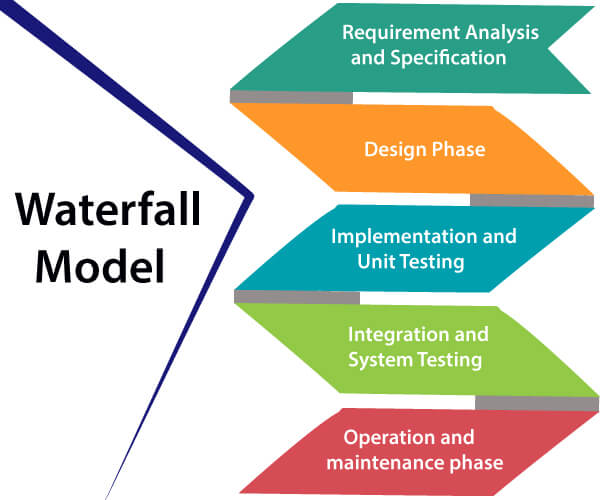
2. Design Phase: This phase aims to transform the requirements gathered in the SRS into a suitable form which permits further coding in a programming language. It defines the overall software architecture together with high level and detailed design. All this work is documented as a Software Design Document (SDD).
3. Implementation and unit testing: During this phase, design is implemented. If the SDD is complete, the implementation or coding phase proceeds smoothly, because all the information needed by software developers is contained in the SDD.
During testing, the code is thoroughly examined and modified. Small modules are tested in isolation initially. After that these modules are tested by writing some overhead code to check the interaction between these modules and the flow of intermediate output.
4. Integration and System Testing: This phase is highly crucial as the quality of the end product is determined by the effectiveness of the testing carried out. The better output will lead to satisfied customers, lower maintenance costs, and accurate results. Unit testing determines the efficiency of individual modules. However, in this phase, the modules are tested for their interactions with each other and with the system.
5. Operation and maintenance phase: Maintenance is the task performed by every user once the software has been delivered to the customer, installed, and operational.
When to use SDLC Waterfall Model?
Some Circumstances where the use of the Waterfall model is most suited are:
- When the requirements are constant and not changed regularly.
- A project is short
- The situation is calm
- Where the tools and technology used is consistent and is not changing
- When resources are well prepared and are available to use.
Advantages of Waterfall model
- This model is simple to implement also the number of resources that are required for it is minimal.
- The requirements are simple and explicitly declared; they remain unchanged during the entire project development.
- The start and end points for each phase is fixed, which makes it easy to cover progress.
- The release date for the complete product, as well as its final cost, can be determined before development.
- It gives easy to control and clarity for the customer due to a strict reporting system.
Disadvantages of Waterfall model
- In this model, the risk factor is higher, so this model is not suitable for more significant and complex projects.
- This model cannot accept the changes in requirements during development.
- It becomes tough to go back to the phase. For example, if the application has now shifted to the coding phase, and there is a change in requirement, It becomes tough to go back and change it.
- Since the testing done at a later stage, it does not allow identifying the challenges and risks in the earlier phase, so the risk reduction strategy is difficult to prepare.
Spiral Model
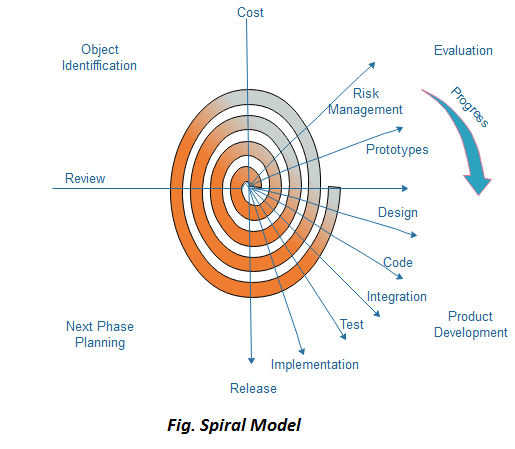
The spiral model, initially proposed by Boehm, is an evolutionary software process model that couples the iterative feature of prototyping with the controlled and systematic aspects of the linear sequential model. It implements the potential for rapid development of new versions of the software. Using the spiral model, the software is developed in a series of incremental releases. During the early iterations, the additional release may be a paper model or prototype. During later iterations, more and more complete versions of the engineered system are produced.
The Spiral Model is shown in fig:
Each cycle in the spiral is divided into four parts:
Objective setting: Each cycle in the spiral starts with the identification of purpose for that cycle, the various alternatives that are possible for achieving the targets, and the constraints that exists.
Risk Assessment and reduction: The next phase in the cycle is to calculate these various alternatives based on the goals and constraints. The focus of evaluation in this stage is located on the risk perception for the project.
Development and validation: The next phase is to develop strategies that resolve uncertainties and risks. This process may include activities such as benchmarking, simulation, and prototyping.
Planning: Finally, the next step is planned. The project is reviewed, and a choice made whether to continue with a further period of the spiral. If it is determined to keep, plans are drawn up for the next step of the project.
The development phase depends on the remaining risks. For example, if performance or user-interface risks are treated more essential than the program development risks, the next phase may be an evolutionary development that includes developing a more detailed prototype for solving the risks.
The risk-driven feature of the spiral model allows it to accommodate any mixture of a specification-oriented, prototype-oriented, simulation-oriented, or another type of approach. An essential element of the model is that each period of the spiral is completed by a review that includes all the products developed during that cycle, including plans for the next cycle. The spiral model works for development as well as enhancement projects.
When to use Spiral Model?
- When deliverance is required to be frequent.
- When the project is large
- When requirements are unclear and complex
- When changes may require at any time
- Large and high budget projects
Advantages
- High amount of risk analysis
- Useful for large and mission-critical projects.
Disadvantages
- Can be a costly model to use.
- Risk analysis needed highly particular expertise
- Doesn't work well for smaller projects.
Incremental Model
Incremental Model is a process of software development where requirements divided into multiple standalone modules of the software development cycle. In this model, each module goes through the requirements, design, implementation and testing phases. Every subsequent release of the module adds function to the previous release. The process continues until the complete system achieved.
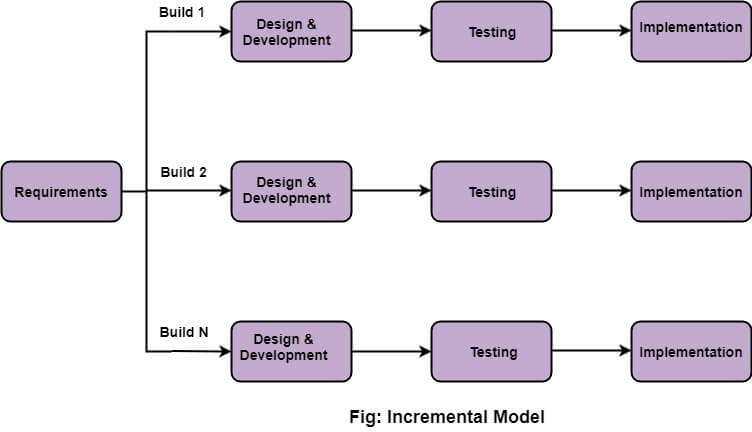
The various phases of incremental model are as follows:
1. Requirement analysis: In the first phase of the incremental model, the product analysis expertise identifies the requirements. And the system functional requirements are understood by the requirement analysis team. To develop the software under the incremental model, this phase performs a crucial role.
2. Design & Development: In this phase of the Incremental model of SDLC, the design of the system functionality and the development method are finished with success. When software develops new practicality, the incremental model uses style and development phase.
3. Testing: In the incremental model, the testing phase checks the performance of each existing function as well as additional functionality. In the testing phase, the various methods are used to test the behavior of each task.
4. Implementation: Implementation phase enables the coding phase of the development system. It involves the final coding that design in the designing and development phase and tests the functionality in the testing phase. After completion of this phase, the number of the product working is enhanced and upgraded up to the final system product
When we use the Incremental Model?
- When the requirements are superior.
- A project has a lengthy development schedule.
- When Software team are not very well skilled or trained.
- When the customer demands a quick release of the product.
- You can develop prioritized requirements first.
Advantage of Incremental Model
- Errors are easy to be recognized.
- Easier to test and debug
- More flexible.
- Simple to manage risk because it handled during its iteration.
- The Client gets important functionality early.
Disadvantage of Incremental Model
- Need for good planning
- Total Cost is high.
- Well defined module interfaces are needed.
Agile Model
The meaning of Agile is swift or versatile."Agile process model" refers to a software development approach based on iterative development. Agile methods break tasks into smaller iterations, or parts do not directly involve long term planning. The project scope and requirements are laid down at the beginning of the development process. Plans regarding the number of iterations, the duration and the scope of each iteration are clearly defined in advance.
Each iteration is considered as a short time "frame" in the Agile process model, which typically lasts from one to four weeks. The division of the entire project into smaller parts helps to minimize the project risk and to reduce the overall project delivery time requirements. Each iteration involves a team working through a full software development life cycle including planning, requirements analysis, design, coding, and testing before a working product is demonstrated to the client.

Phases of Agile Model:
Following are the phases in the Agile model are as follows:
- Requirements gathering
- Design the requirements
- Construction/ iteration
- Testing/ Quality assurance
- Deployment
- Feedback
1. Requirements gathering: In this phase, you must define the requirements. You should explain business opportunities and plan the time and effort needed to build the project. Based on this information, you can evaluate technical and economic feasibility.
2. Design the requirements: When you have identified the project, work with stakeholders to define requirements. You can use the user flow diagram or the high-level UML diagram to show the work of new features and show how it will apply to your existing system.
3. Construction/ iteration: When the team defines the requirements, the work begins. Designers and developers start working on their project, which aims to deploy a working product. The product will undergo various stages of improvement, so it includes simple, minimal functionality.
4. Testing: In this phase, the Quality Assurance team examines the product's performance and looks for the bug.
5. Deployment: In this phase, the team issues a product for the user's work environment.
6. Feedback: After releasing the product, the last step is feedback. In this, the team receives feedback about the product and works through the feedback.
When to use the Agile Model?
- When frequent changes are required.
- When a highly qualified and experienced team is available.
- When a customer is ready to have a meeting with a software team all the time.
- When project size is small.
Advantage(Pros) of Agile Method
- Frequent Delivery
- Face-to-Face Communication with clients.
- Efficient design and fulfils the business requirement.
- Anytime changes are acceptable.
- It reduces total development time.
Disadvantages(Cons) of Agile Model
- Due to the shortage of formal documents, it creates confusion and crucial decisions taken throughout various phases can be misinterpreted at any time by different team members.
- Due to the lack of proper documentation, once the project completes and the developers allotted to another project, maintenance of the finished project can become a difficulty.
Project Management
A project is a group of tasks that need to complete to reach a clear result. A project also defines as a set of inputs and outputs which are required to achieve a goal. Projects can vary from simple to difficult and can be operated by one person or a hundred.
Projects usually described and approved by a project manager or team executive. They go beyond their expectations and objects, and it's up to the team to handle logistics and complete the project on time. For good project development, some teams split the project into specific tasks so they can manage responsibility and utilize team strengths.
What is software project management?
Software project management is an art and discipline of planning and supervising software projects. It is a sub-discipline of software project management in which software projects planned, implemented, monitored and controlled.
It is a procedure of managing, allocating and timing resources to develop computer software that fulfills requirements.
In software Project Management, the client and the developers need to know the length, period and cost of the project.
Prerequisite of software project management?
There are three needs for software project management. These are:
- Time
- Cost
- Quality
It is an essential part of the software organization to deliver a quality product, keeping the cost within the client?s budget and deliver the project as per schedule. There are various factors, both external and internal, which may impact this triple factor. Any of three-factor can severely affect the other two.
COCOMO Model
Boehm proposed COCOMO (Constructive Cost Estimation Model) in 1981.COCOMO is one of the most generally used software estimation models in the world. COCOMO predicts the efforts and schedule of a software product based on the size of the software.
The necessary steps in this model are:
- Get an initial estimate of the development effort from evaluation of thousands of delivered lines of source code (KDLOC).
- Determine a set of 15 multiplying factors from various attributes of the project.
- Calculate the effort estimate by multiplying the initial estimate with all the multiplying factors i.e., multiply the values in step1 and step2.
The initial estimate (also called nominal estimate) is determined by an equation of the form used in the static single variable models, using KDLOC as the measure of the size. To determine the initial effort E~i~ in person-months the equation used is of the type is shown below
E~i~=a*(KDLOC)b
The value of the constant a and b are depends on the project type.
In COCOMO, projects are categorized into three types:
- Organic
- Semidetached
- Embedded
1.Organic: A development project can be treated of the organic type, if the project deals with developing a well-understood application program, the size of the development team is reasonably small, and the team members are experienced in developing similar methods of projects. Examples of this type of projects are simple business systems, simple inventory management systems, and data processing systems.
2. Semidetached: A development project can be treated with semidetached type if the development consists of a mixture of experienced and inexperienced staff. Team members may have finite experience in related systems but may be unfamiliar with some aspects of the order being developed. Example of Semidetached system includes developing a new operating system (OS), a Database Management System (DBMS), and complex inventory management system.
3. Embedded: A development project is treated to be of an embedded type, if the software being developed is strongly coupled to complex hardware, or if the stringent regulations on the operational method exist. For Example: ATM, Air Traffic control.
For three product categories, Bohem provides a different set of expression to predict effort (in a unit of person month)and development time from the size of estimation in KLOC(Kilo Line of code) efforts estimation takes into account the productivity loss due to holidays, weekly off, coffee breaks, etc.
According to Boehm, software cost estimation should be done through three stages:
- Basic Model
- Intermediate Model
- Detailed Model
Risk Management
A software project can be concerned with a large variety of risks. In order to be adept to systematically identify the significant risks which might affect a software project, it is essential to classify risks into different classes. The project manager can then check which risks from each class are relevant to the project.
There are three main classifications of risks which can affect a software project:
- Project risks
- Technical risks
- Business risks
1. Project risks: Project risks concern differ forms of budgetary, schedule, personnel, resource, and customer-related problems. A vital project risk is schedule slippage. Since the software is intangible, it is very tough to monitor and control a software project. It is very tough to control something which cannot be identified. For any manufacturing program, such as the manufacturing of cars, the plan executive can recognize the product taking shape.
2. Technical risks: Technical risks concern potential method, implementation, interfacing, testing, and maintenance issue. It also consists of an ambiguous specification, incomplete specification, changing specification, technical uncertainty, and technical obsolescence. Most technical risks appear due to the development team's insufficient knowledge about the project.
3. Business risks: This type of risks contain risks of building an excellent product that no one need, losing budgetary or personnel commitments, etc.
Other risk categories
- 1. Known risks: Those risks that can be uncovered after careful assessment of the project program, the business and technical environment in which the plan is being developed, and more reliable data sources (e.g., unrealistic delivery date)
- 2. Predictable risks: Those risks that are hypothesized from previous project experience (e.g., past turnover)
- 3. Unpredictable risks: Those risks that can and do occur, but are extremely tough to identify in advance.
Principle of Risk Management
- Global Perspective: In this, we review the bigger system description, design, and implementation. We look at the chance and the impact the risk is going to have.
- Take a forward-looking view: Consider the threat which may appear in the future and create future plans for directing the next events.
- Open Communication: This is to allow the free flow of communications between the client and the team members so that they have certainty about the risks.
- Integrated management: In this method risk management is made an integral part of project management.
- Continuous process: In this phase, the risks are tracked continuously throughout the risk management paradigm.
References
- https://www.geeksforgeeks.org/software-development-life-cycle-sdlc/
- https://www.javatpoint.com/software-engineering-software-development-life-cycle
- https://www.javatpoint.com/software-processes
- https://www.javatpoint.com/software-processes
- https://www.javatpoint.com/software-engineering-sdlc-models
- https://www.javatpoint.com/software-engineering-waterfall-model
- https://www.javatpoint.com/software-engineering-spiral-model
- https://www.javatpoint.com/software-engineering-agile-model
- https://www.javatpoint.com/software-project-management
- https://www.javatpoint.com/cocomo-model
- https://www.javatpoint.com/software-engineering-risk-management